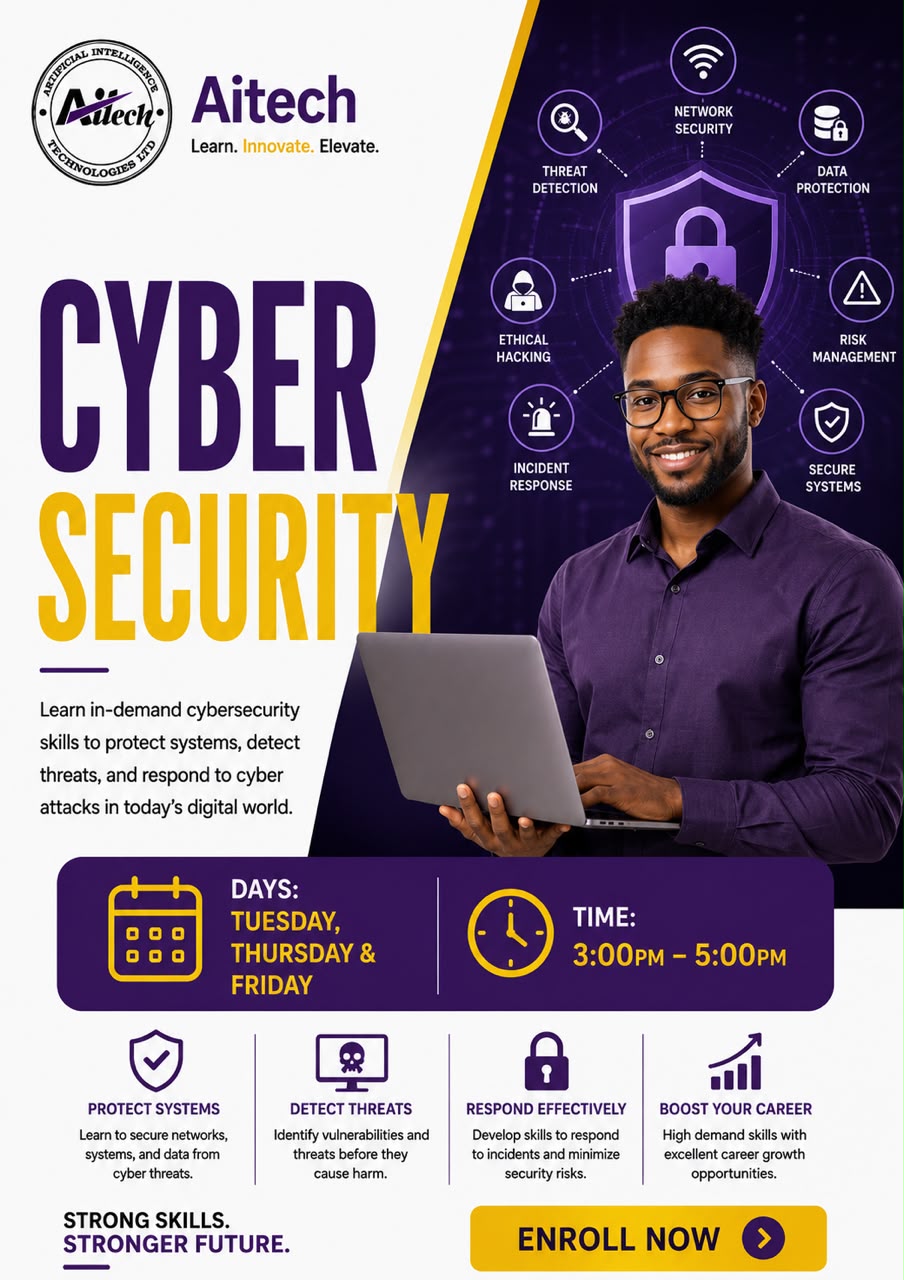
Why Learn Cybersecurity with AITECH in Abuja
Cybersecurity has become a hot subject globally. In this article Why Learn Cybersecurity with AITECH in Abuja, we will offer reasons why you should learn cybersecurity with us.
Cybersecurity has become one of the fastest-growing and highest-paying career fields globally. As organizations increasingly adopt digital technologies, cloud computing, artificial intelligence, and remote work, cyber threats have become more sophisticated than ever. From ransomware attacks and data breaches to phishing campaigns and insider threats, businesses are investing heavily in cybersecurity professionals who can protect their digital assets.
In Abuja and across Nigeria, the demand for cybersecurity professionals continues to rise in banking, telecommunications, government agencies, healthcare institutions, fintech companies, and multinational organisations. Abuja, Nigeria's administrative and technology hub, presents tremendous opportunities for individuals seeking careers in cybersecurity.
If you are looking for the best place to learn cybersecurity in Abuja, AITECH stands out as a leading technology training institution offering a comprehensive, industry-focused Cybersecurity and AI program designed to prepare students for real-world security challenges.
Unlike many training centers that focus solely on theory, AITECH combines practical labs, real-life projects, AI integration, and hands-on experience with industry-standard tools to ensure graduates are job-ready.
Why Cybersecurity Is One of the Best Careers Today
The cybersecurity industry offers numerous benefits:
- High demand globally and locally.
- Excellent salary potential.
- Opportunities for remote work.
- Career flexibility across industries.
- Continuous learning and innovation.
- Opportunities to work with Artificial Intelligence.
- Access to international certifications.
- Entrepreneurial opportunities in consulting and training.
According to industry reports, millions of cybersecurity positions remain unfilled worldwide. Organizations are actively searching for professionals who understand network security, ethical hacking, digital forensics, governance, risk management, and AI-powered security operations.
At AITECH, students are trained to become versatile cybersecurity professionals capable of working in Security Operations Centers (SOC), penetration testing teams, compliance departments, and incident response units.
We hope we are gradually responding to the question; Why Learn Cybersecurity with AITECH in Abuja satisfactorily.
Why Choose AITECH for Cybersecurity Training in Abuja?
AITECH is committed to producing world-class technology professionals in Nigeria through practical, hands-on training.
Here are some reasons students choose AITECH:
- Comprehensive curriculum covering beginner to advanced topics.
- AI-integrated cybersecurity training.
- Real-world projects and simulations.
- Experienced instructors.
- Industry-standard tools and laboratories.
- Career guidance and mentorship.
- Small class sizes.
- Flexible learning options.
- Certification preparation support.
- Networking opportunities within Abuja's technology ecosystem.
The program is designed for:
- Students.
- IT professionals.
- Network engineers.
- Software developers.
- Business analysts.
- Project managers.
- Entrepreneurs.
- Graduates seeking career transitions.
- Government employees.
- Anyone interested in technology and cybersecurity.
These are some of the reasons Why you should Learn Cybersecurity with AITECH in Abuja
What you will learn in our cybersecurity training
1. Cybersecurity Foundations
Every cybersecurity professional begins with understanding the fundamentals.
Introduction to Cybersecurity
Students learn:
- What cybersecurity is.
- Why organizations need cybersecurity.
- Types of cyber threats.
- Current trends in cybercrime.
- Global cybersecurity landscape.
Understanding the basics creates a strong foundation upon which advanced skills are built.
CIA Triad
The CIA Triad consists of:
- Confidentiality
- Integrity
- Availability
Students learn how organizations ensure that sensitive information remains protected, accurate, and accessible when needed.
Defense-in-Depth and Zero Trust
Modern organizations no longer rely on a single security control.
Students explore:
- Layered security approaches.
- Multi-factor authentication.
- Identity management.
- Zero Trust architecture.
Zero Trust has become a key strategy for protecting enterprise environments.
Security Roles and Career Paths
Students discover various career options, including:
- Security Analyst.
- SOC Analyst.
- Penetration Tester.
- Digital Forensics Investigator.
- GRC Specialist.
- Security Engineer.
- Security Consultant.
- Chief Information Security Officer (CISO).
Threats, Vulnerabilities, and Attacks
Topics include:
- Malware.
- Phishing.
- Ransomware.
- Insider threats.
- Social engineering.
- Advanced Persistent Threats (APTs).
Security Policies and Awareness
Organizations depend on strong policies and user awareness.
Students learn:
- Security policies.
- Acceptable use policies.
- Password management.
- Security awareness programs.
Benefits
By completing this module, students understand how cyberattacks occur and how organizations defend against them.
2. Networking Fundamentals
Cybersecurity professionals must understand how networks function.
OSI and TCP/IP Models
Students learn:
- Seven layers of the OSI model.
- TCP/IP architecture.
- Data communication principles.
Understanding these models helps students troubleshoot and secure networks effectively.
IP Addressing and Subnetting
Topics include:
- IPv4.
- IPv6.
- Subnet calculations.
- Network segmentation.
Routing, Switching, and VLANs
Students learn how modern networks are designed using:
- Routers.
- Switches.
- Virtual LANs.
Network Devices and Topologies
Coverage includes:
- Firewalls.
- Access points.
- Load balancers.
- Mesh networks.
Packet Analysis and Monitoring
Students analyze network traffic to identify suspicious activities.
Network Hardening
Topics include:
- Secure configurations.
- Access control.
- Firewall implementation.
Tools Used
- Packet Tracer.
- Wireshark.
- PFsense.
Benefits
Students gain the networking skills required for cybersecurity certifications and real-world security roles.
3. Operating Systems and Administration
Cybersecurity professionals work extensively with Windows and Linux.
Windows Security and Logging
Students learn:
- Event Viewer.
- Windows Defender.
- Group Policies.
- Security logs.
PowerShell Basics
PowerShell enables automation and administration.
Students use PowerShell to:
- Manage systems.
- Automate tasks.
- Collect logs.
Linux Commands and Permissions
Linux remains essential in cybersecurity.
Topics include:
- File permissions.
- User management.
- Directory structures.
Bash Scripting
Students automate tasks using Bash scripts.
Service and User Management
Coverage includes:
- Managing services.
- Creating users.
- Access control.
Tools
- Kali Linux.
- Ubuntu.
- Windows Server.
Benefits
Graduates become comfortable navigating both Windows and Linux environments.
4. Governance, Risk, and Compliance (GRC)
Cybersecurity extends beyond technology.
Governance and Security Policies
Students learn how organizations establish security governance structures.
Risk Assessment and Risk Management
Topics include:
- Risk identification.
- Risk analysis.
- Risk treatment.
Compliance Frameworks
Students study:
- NIST Cybersecurity Framework.
- ISO 27001.
- CIS Controls.
- PCI DSS.
- GDPR.
Auditing and Business Continuity
Coverage includes:
- Disaster recovery.
- Business continuity planning.
- Internal audits.
Practical Projects
Students complete:
- Risk Registers.
- Security Policies.
- Compliance Gap Analysis.
Benefits
Graduates can pursue careers in compliance, auditing, and risk management.
5. Security Operations and Defensive Security
Modern organizations rely on Security Operations Centers (SOC).
SOC Fundamentals
Students understand:
- SOC structure.
- SOC roles.
- Security workflows.
Log Analysis and Threat Detection
Topics include:
- Event analysis.
- Threat identification.
- Alert triage.
SIEM Basics
Students learn Security Information and Event Management concepts.
Incident Response
Coverage includes:
- Detection.
- Containment.
- Recovery.
- Lessons learned.
Threat Hunting
Students proactively identify hidden threats.
Endpoint Security
Topics include:
- Antivirus.
- Endpoint Detection and Response (EDR).
Threat Intelligence Integration
Students learn how organizations use intelligence feeds to improve security.
Tools
- Splunk.
- Wazuh.
- Sysmon.
- Microsoft Defender.
- VirusTotal.
Benefits
Students gain experience required for SOC Analyst positions.
6. Network Security
Protecting enterprise networks remains critical.
Topics Covered
- Firewalls.
- VPNs.
- IDS/IPS.
- Secure network design.
- Traffic analysis.
- Network segmentation.
Tools
- Suricata.
- Wireshark.
Benefits
Students learn how to secure enterprise environments against cyber threats.
7. Ethical Hacking and Penetration Testing
Ethical hackers identify weaknesses before criminals exploit them.
Pentesting Methodology
Students learn:
- Planning.
- Reconnaissance.
- Exploitation.
- Reporting.
Reconnaissance and Enumeration
Topics include:
- Open-source intelligence.
- Domain enumeration.
- Information gathering.
Vulnerability Scanning
Students identify weaknesses using automated tools.
Exploitation Basics
Students understand controlled exploitation within legal and ethical boundaries.
Privilege Escalation
Coverage includes techniques used to understand how attackers gain elevated access in lab environments.
Reporting
Students produce professional penetration testing reports.
Tools
- Kali Linux.
- Nmap.
- Metasploit.
Benefits
Graduates can pursue ethical hacking and penetration testing careers.
8. Web Application Security
Web applications remain among the most attacked systems globally.
OWASP Top 10
Students study:
- Injection attacks.
- Broken authentication.
- Security misconfigurations.
- Cross-site scripting.
- Access control vulnerabilities.
Practical Labs
Students use:
- OWASP Juice Shop.
Benefits
Students learn how to identify and mitigate web application vulnerabilities.
9. Vulnerability Management and Application Security
Organizations continuously identify and remediate vulnerabilities.
Topics Covered
- Vulnerability lifecycle.
- CVSS scoring.
- Risk prioritization.
- Patch management.
- SAST.
- DAST.
- Secure SDLC.
Tools
- Nessus.
- SonarQube.
Benefits
Graduates learn how organizations maintain secure systems throughout their lifecycle.
10. AI Fundamentals for Cybersecurity
Artificial Intelligence is transforming cybersecurity.
Topics Covered
- Machine Learning.
- Generative AI.
- Large Language Models.
- Prompt Engineering.
- AI security risks.
Students learn how AI can improve efficiency while understanding associated risks.
Benefits
Graduates remain competitive in an AI-driven cybersecurity landscape.
11. AI-Powered SOC and Threat Detection
Modern SOCs increasingly leverage AI.
Students Learn
- AI-assisted log analysis.
- AI threat hunting.
- AI incident response.
- Automated IOC analysis.
- AI detection engineering.
Projects
- AI SIEM Assistant.
- AI Threat Intelligence Workflow.
Benefits
Students gain exposure to next-generation security operations.
12. AI-Powered Governance, Risk, and Compliance
Artificial Intelligence can automate many compliance activities.
Topics Include
- AI risk assessments.
- AI policy generation.
- Compliance automation.
- AI audit assistance.
- Governance dashboards.
Projects
- AI Risk Register.
- AI Compliance Mapping.
Benefits
Students learn how to improve organizational efficiency using AI.
13. AI-Powered Penetration Testing
AI is revolutionizing offensive security.
Topics Covered
- AI-assisted reconnaissance.
- AI vulnerability analysis.
- AI pentest reporting.
- AI OSINT automation.
- AI-assisted web testing.
Projects
- AI Recon Workflow.
- AI Pentest Report Generator.
Benefits
Students develop future-ready offensive security skills.
14. Digital Forensics and Incident Response
Cybersecurity professionals frequently investigate security incidents.
Incident Response Lifecycle
Students learn:
- Preparation.
- Identification.
- Containment.
- Eradication.
- Recovery.
- Post-incident review.
Memory and Disk Forensics
Topics include:
- RAM analysis.
- Disk imaging.
- Evidence preservation.
Log Analysis
Students identify indicators of compromise from logs.
Malware Investigation
Students investigate malware behavior in controlled environments.
Evidence Handling
Students learn:
- Chain of custody.
- Documentation.
- Legal considerations.
Tools
- Volatility.
- Autopsy.
- FTK Imager.
Benefits
Graduates can pursue careers in digital forensics and incident response.
Why Learn Cybersecurity with AITECH in Abuja? It is no longer difficult to see why after going through the comprehensive course outline.
Hands-On Learning at AITECH
One of the major advantages of learning at AITECH is the emphasis on practical training.
Students work with:
- Wireshark.
- Splunk.
- Wazuh.
- Kali Linux.
- Nmap.
- Nessus.
- SonarQube.
- Suricata.
- Volatility.
- Autopsy.
- Metasploit.
- Microsoft Defender.
- PFsense.
This hands-on approach ensures students gain practical experience before entering the workforce.
Career Opportunities After Completing the Program
Graduates can pursue roles such as:
- Cybersecurity Analyst.
- SOC Analyst.
- Security Engineer.
- Penetration Tester.
- Incident Response Analyst.
- Digital Forensics Investigator.
- Vulnerability Analyst.
- GRC Specialist.
- Security Consultant.
- Security Architect.
- Compliance Officer.
- Threat Hunter.
- AI Security Specialist.
Many of these roles offer opportunities for international employment and remote work.
Why Abuja Is an Excellent Place to Learn Cybersecurity
Abuja continues to experience significant growth in:
- Technology startups.
- Government digital initiatives.
- Banking and fintech.
- Telecommunications.
- International organizations.
- Consulting firms.
The city's growing technology ecosystem creates numerous opportunities for aspiring cybersecurity professionals.
Final Thoughts
Cybersecurity is no longer optional—it is essential. Every organization, regardless of size or industry, needs professionals capable of protecting systems, networks, applications, and data.
AITECH's Cybersecurity and AI program goes beyond traditional training by combining cybersecurity fundamentals, ethical hacking, governance, digital forensics, and artificial intelligence into one comprehensive curriculum. Students graduate with practical experience, exposure to industry-standard tools, and the confidence to succeed in one of the world's most exciting industries.
Whether you are a beginner seeking a career change or an IT professional looking to advance your skills, AITECH provides the knowledge, mentorship, and practical experience needed to thrive in cybersecurity.
If you are searching for the best cybersecurity training in Abuja, AITECH offers a future-focused learning experience designed to prepare you for the challenges of today's digital world and the opportunities of tomorrow.
After reading this article we hope you are now convinced on why to learn cyber security with AITECH